
INTRODUCTION
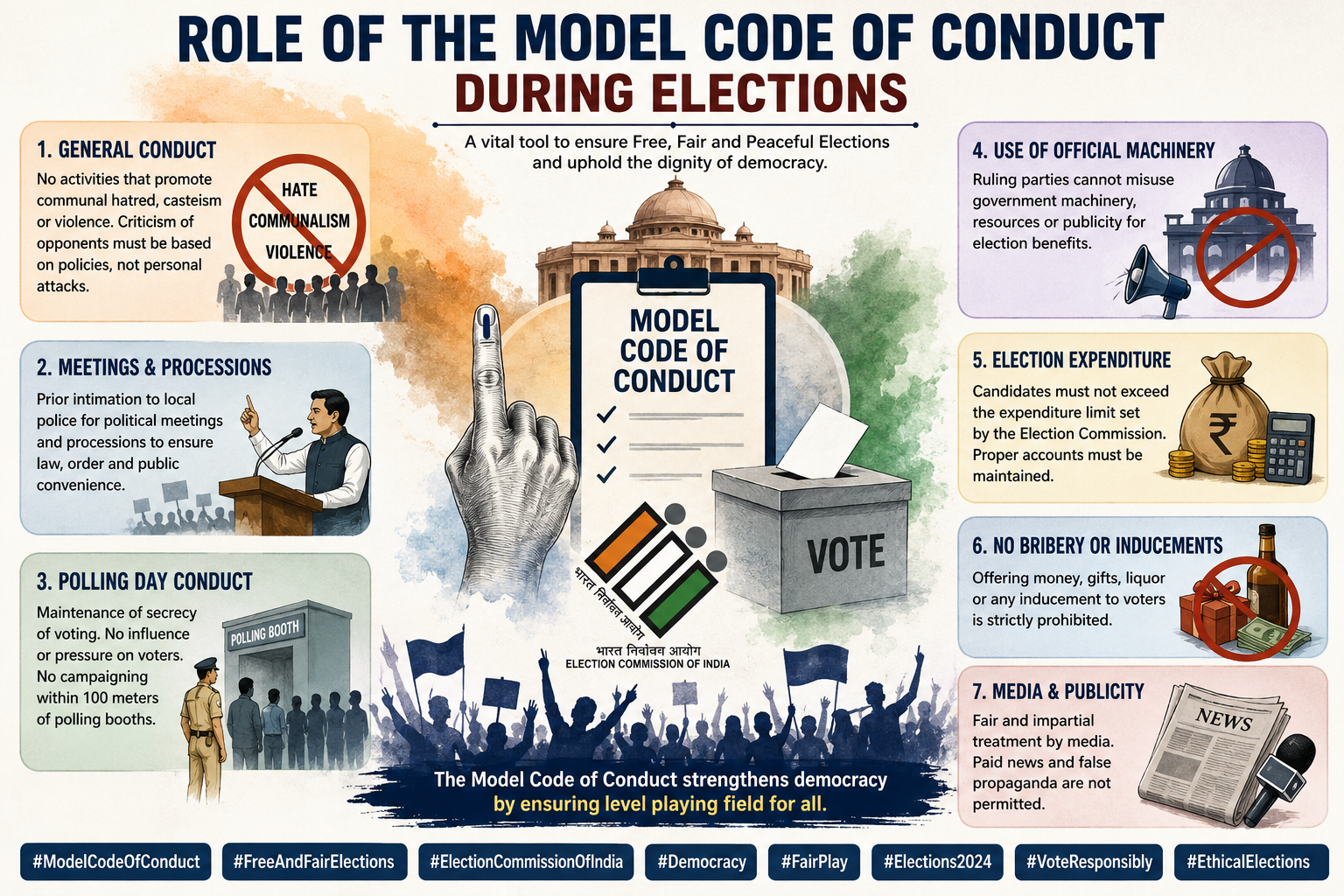
The “Model Code of Conduct” can be defined as something essential and a vital tool that helps conduct free & fair elections in a country. It serves as a guide for political parties as well as candidates. The “Model Code of Conduct” directs the political parties & candidates created by the former agreeing to uphold the principles set in their respective codes by the Election Commission of India. It also requires the political parties & the candidates to defend it in letter & spirit. It is a non-statutory framework which is a.k.a “achar sanchita” in Hindi as a set of guidelines for how political parties & candidates should conduct themselves during an election. It keeps an eye on speeches, on the day of the election, places for polling, portfolios, election manifestations, processes & general behavior. This set of guidelines was developed with the assistance of the political parties that pledge to maintain the principles outlined in the code respectively in letter & spirit. The Model Code of Conduct is implemented as soon as the commission makes the schedule of election available to the public guaranteeing free & fair elections. The main objective is to prevent the ruling parties in the Centre & State government from abusing their advantageous positions. The goal is to prevent the conduct that the Model Code of Conduct deems as corrupt.
Historical Background
The evolution of the Model Code of Conduct has its roots embedded in the State of Kerala throwing back to the year of 1960’s. The state of Kerala was the first to adopt a Model Code of Conduct for the elections in the state. A draft was prepared by the administration which covered the important aspects of electioneering such as the processions, the rallies that the party conducts, & the speeches. Dating back to the year 1974 the Election Commission of India released a formal Model Code of Conduct, which also led to the setting up of bureaucratic bodies at the district level to oversee the implementation. But before the year 1977, the M.C.C. had only the role to guide the political parties & the candidates. In the year 1979, the Election Commission learned that the parties in power were misusing the same monopolizing public spaces & using them for advertisements being funded or financed by the hard-earned money of the general public. The M.C.C. was then revised by the Election Commission of India to include the ruling political parties. The M.C.C. that had been revised was bifurcated into 7 parts, with one for the ruling party’s behavior after the announcement of the election.
Part 1 covers or deals with the general good behavior of the parties & the candidates.
Parts 2 &3 respectively cover or deal with the rules for public meetings & processions.
Parts 4 & 5 provide guidelines for behavior on polling day & at the polling booths.
The M.C.C. has thought or although been revised several times or on occasions since the year 1979, with the last time it being revised in the year 2014.
Evolution of the Model Code of Conduct
The Model Code of Conduct has its evolution with the consensus of political parties to abide by the principles that are embodied in the set code of the Election Commission of India & to respect & observe in its letter as well the spirit. However, the evolution of the code can still over the years be seen as follows:
- The year 1962 had scheduled the general Lok Sabha elections where the election Commission circulated this very code to all the recognized political parties, with the state government being requested to secure the acceptance of the code by the respective parties.
- The year 1967 witnessed the following of the respective code in the Lok Sabha & the general assembly elections.
- The year 1968 the Election Commission conducted meetings with political parties at the state level & further circulated the Code of Conduct to observe minimum standards relating to the behavior to ensure that the elections are free & fair.
- The year 1971-72 which was the year of the general election to the House of People & that of the state Legislative Assemblies, the code was circulated again by the election Commission.
- During the time of general elections to some state assemblies, the code of conduct was issued by the commission to the respective political parties in that state.
Key Provisions of the Model Code of Conduct
In India, the Model Code of Conduct has several key provisions which are inclusive of:
- General Conduct: The political parties & their candidates are not allowed to engage in activities that can stoke communal tensions or promote hatred between the different groups. (Like criticism of the opposite party shall be based on their policies, schemes & past performances overall avoiding any sort of personal attacks.
- Meetings: The party or the candidate must notify the local police authorities for organizing political meetings & election campaigns for organizing of any political meetings & election campaigns for proper management & security & to ensure the arrangements of law & orders.