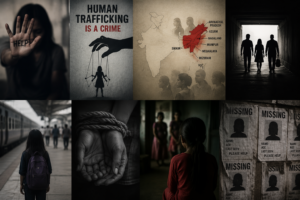

Introduction
Many few are privy to this fun truth with concern to human trafficking that “Human Trafficking” is a multibillion-dollar industry? Yes, you examined it right. As per the report of Worldwide Work Organization, International Labour Organisation (ILO), this industry is worth “One Hundred Fifty Billion Dollars”. The shocking portion being usually that this is a report from 2014. Today, it is worth a lot more. Human Trafficking and forced labour generate illegal profits- about 73%- come from forced commercial sexual exploitation, with the remainder from frced labour in sectors like industry, services, agriculture and domestic work. This makes ’Human Trafficking’ a multi-dollar criminal enterprise. To jump profound down within the matter of Human Trafficking, one must be privy with the elucidation of as to what human trafficking is.
Human Trafficking and Poverty
According to United Nations Office on Drugs and Crimes (UNODP), “Human trafficking is the exchange of people for the reason of constrained labor, sexual subjugation, or commercial sexual misuse”. It includes the enlistment, transportation, exchange, harbouring or receipt of people, by implies of danger or utilize of drive or other shapes of constraint, of snatching, of extortion, of duplicity, of the mishandle of control or of a position of defenselessness or of the giving or accepting of instalments or benefits to attain the assent of an individual having control over another individual, for the reason of abuse.
It is the destitute division of the populace who are abused more through human trafficking as they are the helpless area of the society. They are the ones who are as of now misused by the misfortunes of life, the ones who are battling to walk in this fast-paced life.
Fiendish hones like trafficking adds up to the bridge between the wealthy and the destitute or I must say between the solid and powerless due to which the destitute despite different legislative exertion couldn’t elude the anger of destitution where destitution keeps on expanding with each single day. A few components include up to as to why for the most part the destitute as it is.
Ⅰ) Need of Security: Destitute individuals many times may not have access to the same level of security, support as wealthier people, making them more defenseless to abuse.
Ⅱ) Franticness: Destitutes are more desperate for a better life, making them more susceptible to traffickers’ false promises and manipulation.
Ⅲ) Corruption and Imbalance: Both corruption and imbalance empower the trafficker to function with exemption, making it troublesome for destitute individuals to get to equity and security.
Ⅳ) Relocation and Uprooting: Destitute individuals may move in look of superior openings, but traffickers regularly target them in travel or at their goal, abusing their helplessness and edginess.
Ⅴ) Need of information: Casualties of human trafficking frequently confront noteworthy boundaries to collaborating with law authorization, counting fear, injury, and need of believe.
Ⅵ) Need of Assets: Destitute individuals frequently need get to assets, instruction, and work openings, making them more powerless to wrong which guarantees a misuse against them as they lack the required resources.
These variables contribute to the powerlessness and misuse of destitute individuals in human trafficking which highlights to us the requirement for tending to the comprehensive measures to address destitution, disparity, social and social components that contribute to helplessness. “This is one of the foremost brutal ways of encroaching the human rights of an individual, still numerous do not converse about it as it is an outsider subject. It ought to be examined more, debated more and must be taken very genuinely and seriously. More than five hundred million individuals within the world are getting abused right presently due to it but this subject isn’t given sufficient cognizance as required in its genuine sense. It is still to this date taken exceptionally gently which indeed a matter of concern.”
Trafficking and Rare Talk
Ⅰ) Ignorance: Numerous individuals are basically unconscious of the complete scope and scale of human trafficking, numerous do not know the meaning in its genuine sense because it is frequently covered up. Without legitimate instruction and mindfulness campaigns, it remains a misconstrued issue which confine stalks.
Ⅱ) Our News Media Framework: It is exceptionally pitiful to say that our media framework being a private institution tends to show news which can assemble more potential viewership for benefit reason wherein points like trafficking are cleared out untouched. Indeed, in the event that sex thrilling outrages including trafficking of ladies and children which clears out other shapes like constrained labor, child labor inferred. These skews open discernment around human trafficking.
Ⅲ) Muscle Control: In a few cases, there may be a need of political will to handle human trafficking, particularly when it includes capable businesses or interface. This prevents open dialog and activity.
Ⅳ) Diverse Social Culture: In a few societies, certain shapes of misuse, such as child labor or residential subjugation, may be normalized to a few degrees. This makes it harder to recognize as a human rights infringement.
Ⅴ) Disgrace and Casualties: There is always a sense of shame, disgrace amidst sex slaves as in approaching any authority or person seeking assistance. Similarly, Casualties of human trafficking, particularly those misused within the sex exchange, regularly confront shame and disgrace, which avoids them from coming forward. This contributes to the need of open dialog.
It is only we who can alter this disgrace, raise mindfulness and lock in communities intending to the root causes of human trafficking. Our one step can alter the life of millions. In India, North-East has risen as a major concern in human trafficking. Especially for women and children, it has gotten to be a centre for trafficking in later times.
North-East and Its Purview on Human Trafficking
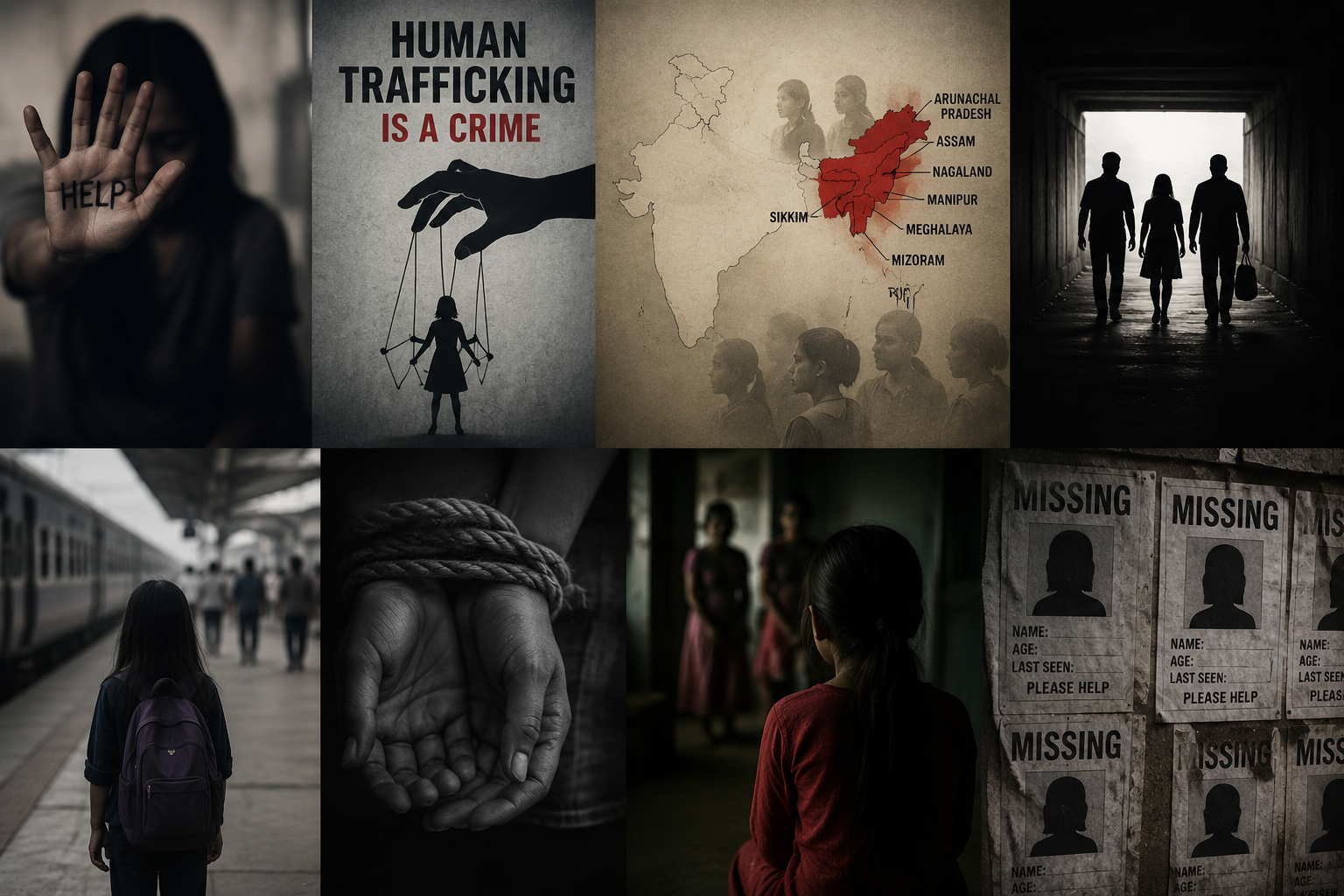
Human Trafficking has emerged as a major concern in the North-East region of India. North-East India officially known as the North-Eastern Region (NER) is the easternmost region of India. It comprises of 8 states: Arunachal Pradesh, Assam, Manipur, Meghalaya, Mizoram, Nagaland, Sikkim and Tripura. It is a very ethnically diverse area with more than 200 ethnic groups having distinct languages, dialects and socio-cultural identities. The region is well known for its natural beauty and a tourist hub. But beyond this lies the harsh reality of Human Trafficking which is a constant problem of struggle for the North-East or we can also say the epicenter for trafficking. This problem is particularly acute in states like Tripura, Arunachal Pradesh, Mizoram and Assam. In Tripura alone, over 3000 women went missing in an 8-month period. The causes of this trafficking are multifaceted and complex, which involves a combination of political, economic and social factors wherein poverty and unemployment are the major driving factor. As due to these two reasons, many people are continuously on the behest of opportunities to a better life, only to get exploited by the traffickers through incitement, deceit, lie and allurement. These traffickers are also on the constant hunt for such people which unfortunately are in abundance leading to unstoppable instances of this hazard.
Another additional and major reason for rising cases in the North-East, hub of trafficking, is the region’s geographical location, with its open international borders and loose security conditions making it an attractive destination for traffickers.
Another very overlooked yet important reason is the North-East region’s historical isolation from the rest of India, which has led to underdevelopment and a lack of economic opportunities. This has resulted in a significant number of people, especially women and children, being trafficked out of the region for forced labour, prostitution, and other forms of exploitation. The region’s proximity to international borders, particularly with Bangladesh and Myanmar, also adds up to being a major transit point for trafficked persons. In a nutshell, human trafficking is a significant problem in North-East India, driven by a combination of economic, social, and political factors. The only organization that a common man can rely on is the police, judicial institution and the protector of laws but the things go way out of hand when everyone is corrupt. In this case, a person getting exploited daily has nowhere to go to get justice. Justice is also a magnanimous word for these people who even cannot talk and share his/her ordeal to anyone as not many bothers to listen to them due to their economic conditions. In the end they are left to suffer in hell in which they cannot even die gracefully or let me say willfully. All this have made human trafficking a very significant problem which has spread to such an extent where it has become intractable, lawless, unmanageable and violent.
Over 3,700 children went missing in Assam in 3 years. Child trafficking cases are reported from almost all districts of the state, with Kamrup, Udalguri, Sonitpur, Kokrajhar, Lakhimpur and Biswanath accounting for most such crimes. 481 children in 5 yrs (2018-2023) have been trafficked. A Caritas India project has exposed the Child Trafficking problems of Assam and Arunachal Pradesh with the outer world. A sample study of 75 villages from Assam and Arunachal Pradesh revealed 2 trafficking, 28 missing, 68 child labour and 60 cases of domestic work by children.
Indian Legal System on Human Trafficking
Our Indian Law has prohibited human trafficking on every fronts. Various laws, statutes have been enacted to prevent and combat this situation of trafficking,
Ⅰ) ARTICLE 23(1) OF THE INDIAN CONSTITUTION,
-According to it, traffic in human beings and beggars and other similar forms of forced labour are prohibited and any contravention of this provision shall be an offense punishable in accordance to law.
Ⅱ) IMMORAL TRAFFIC (PREVENTION) ACT OF 1956 (ITPA)
Ⅲ) PROTECTION OF CHILDREN FROM SEXUAL OFFENCES (POCSO) ACT, 2012
Ⅳ) BONDED LABOUR SYSTEM (ABOLITION) ACT, 1976
Ⅴ) CHILD LABOUR (PROHIBITION and REGULATION) ACT, 1994
Ⅵ) TRANSPLANTATION OF HUMAN ORGANS ACT, 1994
Ⅶ) INDIAN PENAL CODE (IPC) OF 1860,
-Section 372 and section 373 of the IPC prohibits ‘sale, letting on hire or otherwise disposing of a child or, as the case may be, buying, hiring or otherwise obtaining possession of such child.
Consequently, it can be clearly seen that our enactment has made brave endeavours to avoid and control trafficking circumstances but that’s of no utilize in the event that at grass root level no cognizance is taken up by the law requirement offices and the police. The debasement, bribery and carelessness lead to weakening and abuse of all such casualties. In the event that a crime is detailed within the police station, at that point the police must see after the issue but on the off chance that not at that point the destitute, casualty and unprivileged segment of this society can ever come to par shoulder to shoulder with other individuals within the society.
The International conventions has too attempted to avoid issues of trafficking because it isn’t an Indian issue but a worldwide issue which has influenced the globe from ages and proceeds to do so.
International Convention on Human Trafficking
Throughout the century, for more than a hundred years the international missions, treaties, laws, organizations and conventions have also tried to reduce the problem globally. Some of which are:
Ⅰ) Palmero Protocol
-It is to prevent, suppress and punish trafficking in persons, especially women and children, supplementing the UN Convention Against Transnational Organized Crime (Palermo Protocol), is the only universal legally binding instrument on combating human trafficking. It aims to prevent, suppress, and punish trafficking in persons, especially women and children.
Ⅱ) United Nations General Assembly
Ⅲ) United Nations Security Council,
Ⅳ) Organization for Security and Co-operation in Europe (OSCE)
Ⅴ) Multilateral Collaborations
Ⅵ) Group of Experts on Action against Trafficking in Human Beings (GRETA)
Arrangements
Human trafficking may be an exceptionally complex and multifaceted issue that requires a comprehensive and collaborative approach to address. It is very essential to recognize that human trafficking may be an infringement of human rights and a genuine wrongdoing that influences millions of individuals around the world. The arrangement to this issue lies in a combination of administrative, law authorization, and social measures that address the root causes of trafficking and give bolster to casualties.
Firstly, it is exceptionally significant to reinforce our laws and approaches to avoid trafficking and ensure casualties. As more capable our law framework will be more will be the fear among predators which is able to compel them to not commit the wrongdoing, eventually decreasing the figures of human trafficking. This incorporates sanctioning and upholding laws that criminalize trafficking, give punishments for traffickers, and offer security and bolster to casualties. Governments must set up compelling components for detailing and exploring trafficking cases and give preparing to law requirement authorities to recognize and react to trafficking.
Secondly, it is fundamental to address the root causes of trafficking, counting destitution, need of instruction, and sex imbalance. This requires a comprehensive approach that incorporates financial improvement, instruction, and social programs that enable people and communities to form informed choices around their lives.
Thirdly, it is exceptionally significant to supply back to casualties of trafficking. This incorporates giving get to healthcare, counselling, and legitimate help, as well as securing their rights and dignity. Governments must also establish successful components for recognizing casualties and give preparing to benefit suppliers to reply to desires of casualties.
Lastly, it is basic to raise mindfulness almost human trafficking and its results. This requires an intensive open mindfulness campaign that highlights the issue of trafficking and its effect on people and communities. Governments must moreover work to lock in civil society, the private segment, and the media within the battle against trafficking.
We are living in the 21st century and despite various efforts we cannot see halt in this grievous situation whether be it North-East India or globally. Our constitution in its very first page talks about Justice, Liberty, Equality and Fraternity but most importantly it says in the very first line, “WE THE PEOPLE OF INDIA”. We the people of India have several responsibilities towards our nation. To improve the situation of the poor, we all who are sustainable and educated, must come together to serve the nation. Anywhere, any place we encounter child labour, forced labour, sexual exploitation of the voiceless then we must become their voice by raising our voice and report the incident to the nearest police station immediately instead of giving them a blind eye. Our one step can be life changing for these people who are being exploited daily and haven’t even started living yet. This country belongs to them as much as it belongs to me and thyself. By working together, we can prevent trafficking, protect victims, and promote a world where all individuals are free from exploitation and abuse.
IT IS HIGH TIME, WE THE PEOPLE OF INDIA, THE FUTURE OF TOMORROW HAS THE OBLIGATION TO MAKE IT A BEAUTIFUL, PROSPEROUS, DISCRIMINATION FREE, CRIME FREE, CORRUPTION FREE AND MOST IMPORTANTLY FREE FROM EVIL PRACTICES OF HUMAN TRAFFICKING OF WHICH I AM SURE THAT WE ALL WILL ACHIEVE TOGETHER AND MAKE THIS WORLD A BETTER PLACE TO LIVE. JAI BHARAT, JAI HIND!!!