
INTRODUCTION
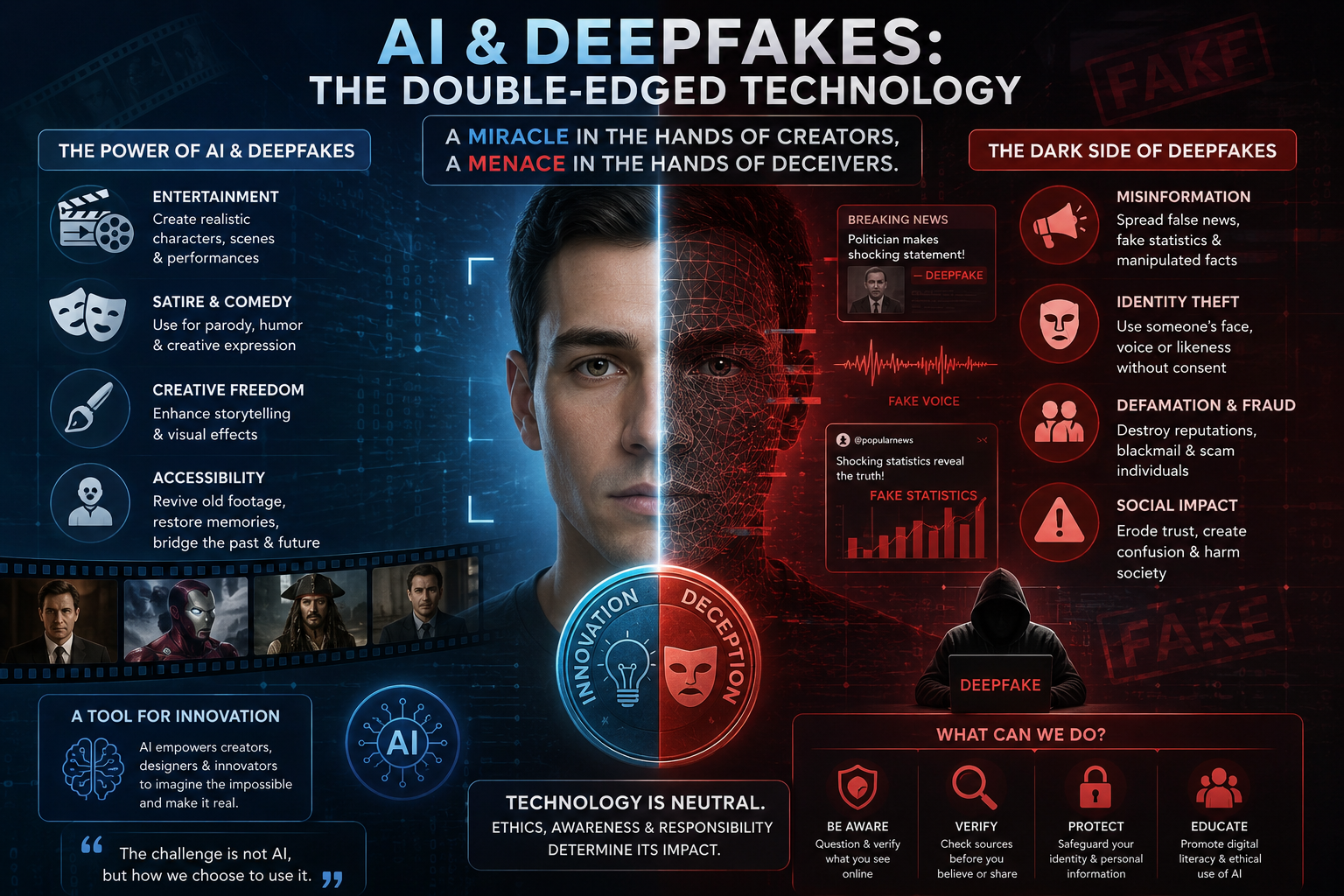
Deepfake & AI are closely related concepts, much like the two sides of the coin. In the modern world or the world that’s largely driven by science the rise of Artificial Intelligence (AI) & Deepfakes technology has emerged as a significant challenge in the digital media. What the Deepfakes typically do is utilize the learning of the machine algorithms to manipulate or generate inauthentic images, videos, certain sounds & voices of an individual without their consent & information. While posing a serious & ethical concern deepfakes are also being used widely for entertainment & or satire. It has the potential to spread fake statistics from the resources generally trusted poses a substantial risk to society as a whole. Deepfake & Artificial Intelligence as a part of technology is a miracle for those who possess skills such as photo-shopping & face- swapping.
History of the Artificial Intelligence & Deepfakes
This journey can be termed as an era marked by the captivating journey of deepfake that is closely related to the usage of AI for creating fairly practical & frequently misleading films & audio recordings that can be altered in many forms & various situations was hardly & rarely seen in decades. The roots of this technological wonder can be traced back to 2011, with the creation of face-swapping tools like the Fake App. It was relatively simple for hackers to replace one face found in a video with another’s face standing for more sophisticated deep-faking technologies. Nonetheless, it served as the stepping stone for greater sophisticated improvements in this subject. In 2017, the deepfake phenomenon gained significant traction on Reddit with the creation of the r/deepfakes subreddit, a hub for those interested in sharing their deepfake builds, brainstorming strategies, and demonstrating power which this technology has the attention of the online community. However, in late 2017 and early 2018, deepfakes began to attract mainstream media attention, prompting public discourse about the potential consequences of this technology, particularly how it is misused for misleading purposes, or is wrong, and raised legitimate concerns about privacy, the impact of trust and the spread of misinformation. The year 2018 also saw the introduction of laws in various countries aimed at dealing with issues related to deepfakes, and some governments attempted to create legal frameworks to regulate the creation and distribution of deepfake information, especially when it violates privacy, security, or public discourse. At the same time, researchers and tech companies have begun to invest heavily in deep-search tools, working tirelessly to develop algorithms and software that can recognize resistant edited videos of the harm that can result from this deceptive media creation an important defense mechanism. As 2019 progressed, deepfake technology advanced rapidly, producing more realistic and authentic results that blurred the line between real and fake, challenging the very notion of authenticity and authenticity in the digital age.[1] New worries have emerged in 2020 as deepfakes, which can be used to influence elections and spread faux information, have turned out to be an increasing number of apparent, prompting governments, political businesses, and technology agencies to intensify their efforts in fighting virtual deception and this new revolution. Then in the year 2022, the Deep Faux panorama is considered one of the continuous advances in generation, diverse detection tools, and countermeasures, and ongoing issues about their abuse potential in a variety of industries consisting of politics, it includes exciting and thriller, making Deepfake History a dynamic and ever-converting story packed with promise and peril. The manipulated or superimposed pre-existing images or videos are placed into the faces or bodies of different persons so that they can appear realistically. What the Key Aspects of Deepfake Technology are:
- Generative Adversarial Networks (GANs): In this respect, deepfakes are usually created with GANs which contain two key elements-the generator and the discriminator. A fake one is generated by the generator whereas a discriminator classifies if what it has been fed with is true or made-up content. These two parts complement each other; the generator becomes better at creating high-quality fake deepfakes, while the discriminator becomes more efficient at exposing such deepfakes.
- Auto-encoder Algorithm: The auto-encoder is another commonly used algorithm in deepfake technology. This compresses the input image or video into a low-dimensional form before converting it back into the reconstructed version. This low-dimensional representation can be tweaked, which enables an auto-encoder to modify the look of its output.
- Face-swapping Algorithm: This provides an algorithm that can detect landmarks (e.g., eyes, nose, and mouth) on the face of a source image/video and the corresponding one in the target image/video. Afterward, it warps and superimposes the source face on top of the target face creating an illusion of natural replacement. What the implications & concerns are:
- a) Misinformation and Deception: For instance, the creation of deepfake videos involving prominent individuals is a clear illustration of how easily deepfakes can proliferate a lot of wrong information and deceive people.
- b) Privacy and Reputation: However, deepfakes have been applied for ill motives like in some revenge porn circumstances and these people’s rights and image are grossly compromised on a serious scale.
- c) Manipulation of Public Figures: Deepfake is a technique for discrediting public personalities, undermining the authenticity of video proofs, and dismantling public confidence in media.
- d) Potential for Political Propaganda and Fraud: Deepfakes are especially dangerous for politics where it is used for propaganda, false informing, and illegal money laundering business. How the challenges can be addressed are:
- a) Detection Efforts: There are researchers as well as policymakers who have been involved in the creation of AI-based detection algorithms that detect disruptions in facial expressions, inconsistent blinking patterns, and other artifacts associated with the manipulation process.
- b) Legislative Measures: Attempts are being taken towards creating rules and policies that can help curb the [2]negative impacts of deepfakes.
Now in this era where digital content can be manipulated easily the concept of “Personality Rights” has become increasingly important. The term Personality Rights denotes an individual’s rights towards as well as control over the commercial use of their name, image, likeness, and identity. These rights protect individuals—especially public figures—from unauthorized exploitation in advertisements, endorsements, and, more recently, deepfake technology.
Personality Rights
Traditionally, personality rights have been protected under privacy laws, intellectual property rights, and defamation laws. However, the rise of artificial intelligence and deepfake technology has created new challenges, as people’s faces and voices can now be digitally replicated without their consent. This raises concerns about misrepresentation, reputational harm, and financial loss, making it crucial for legal systems to adapt. In different countries, the concept of personality rights has been dealt with for instance in the European Union- The civil law traditions protect images based on the right to privacy or the right to personality. In the United Kingdom, the images are protected by the law of torts of breach of confidence & of passing off. Personality rights may thus be seen as an informal & external limitation on copyright law. Personality rights ensure a balanced application of the technology. Using interdisciplinary insights from law & the technical literature. The legal framework for personality rights varies by country. Here are some key points from different jurisdictions:
United States
Personality rights, often referred to as the “right of publicity,” are recognized at the state level. Some states, like California and New York, have well-established laws protecting individuals from unauthorized commercial use of their name, image, or likeness. However, there is no federal right of publicity law.
United Kingdom
The UK does not have specific legislation for personality rights. However, claims can be made under laws related to privacy, defamation, and trademark protection. Celebrities often rely on passing off and trademark laws to protect their image.
India
Personality rights are recognized under Article 21 of the Indian Constitution (Right to Privacy). Courts have ruled that a person has exclusive rights over their name, likeness, and voice, preventing unauthorized commercial use. However, there is no comprehensive statute, and cases are decided based on privacy and publicity principles.
Simultaneously,
Legal Protection in Different Jurisdictions
United States
- No federal law exclusively governs personality rights. However, many states recognize the right to publicity.
- California & New York have strong protections under their right of publicity laws, prohibiting unauthorized use of an individual’s likeness.
- Landmark Case: White v. Samsung Electronics (1992) – The court ruled in favor of Vanna White when Samsung used a robot resembling her likeness in an advertisement without permission.
European Union
- The EU General Data Protection Regulation (GDPR) protects individuals from unauthorized digital manipulation, including AI-generated deepfakes.
- The Right to Be Forgotten under GDPR allows individuals to demand the removal of personal content [3]online.
India
- Personality rights are recognized under privacy laws but lack standalone legislation.
- The Supreme Court in Justice K.S. Puttaswamy v. Union of India (2017) held that privacy is a fundamental right, which may extend to the unauthorized use of personal likeness in deepfakes.
The legal solutions for the same can be:
- Privacy Laws: Deepfakes present a significant threat to privacy. Privacy laws, while not directly purposed for deepfakes, provide a certain degree of protection against their misuse. The photos and videos used to create deepfakes often contain individuals’ data. Processing such data requires the individual’s explicit consent unless the processing falls within exceptions to consent outlined by law, such as the existence of a legitimate interest. Therefore, producing a politician’s deepfake without a legitimate interest or explicit consent is a breach of privacy laws. Erasing or rectifying inaccurate personal data, including deepfakes, is also possible by law, as the European General Data Protection Regulation (GDPR) provides for it.
- Criminal Laws, especially those on privacy, pornography, fraud, and harassment, play a crucial role too in addressing the misuse of deepfakes. For instance, regarding personal data protection, Turkish law sets forth imprisonment for up to four years for individuals who unlawfully provide, distribute[4] or obtain another person’s data (Turkish Criminal Code, 2004, Article 136).
- Civil Laws are another option to impair the suffering resulting from deepfakes. As a result of the creation and dissemination of deepfakes, parties who suffer material or moral damage may have the right to compensation.
- Human Rights Laws Human rights law provides a mechanism to address deepfakes, especially within the context of violations of an individual’s right to privacy. Article 8 of the European Convention for Human Rights (ECHR) recognizes everyone’s right to have their private life respected.
- Copyright Laws Existing copyright laws may prove effective against the misuse of deepfakes. These regulations address the issue of deepfakes to some extent, as deepfakes incorporating copyrighted material may face allegations of copyright infringement. Social media platforms may also be required to remove deepfakes that violate copyright.
[1] https://ijirl.com/wp-content/uploads/2024/05/RISING-MENACE-OF-DEEPFAKES-WITH-THE-HELP-OF-AI-LEGAL-IMPLICATIONS-IN-INDIA.pdf , Volume IV Issue III | ISSN: 2583-0538
[2] Indian Journal of Integrated Research in Law Volume IV Issue III | ISSN: 2583-0538
Khormali, A., & Yuan, J. (2021). ADD: Attention-Based DeepFake Detection Approach
3 https://www.researchgate.net/publication/359711219_Deepfakes_Copyright_Personality_Rights_An_inter-disciplinary_perspective
https://asiaiplaw.com/section/ip-analysts/from-fame-to-frame-how-can-personality-rights-be-secured-against-ai-misuse
[4] https://researchcentre.trtworld.com/wp-content/uploads/2024/03/The-Deepfake-Menace_v2.pdf